

Enterprises are no longer casually discussing RHEL 7 to 9 migration. The tone has changed. The conversation now happens inside risk committees, audit reviews, and modernization workshops.
RHEL 7 Maintenance Support 2 ended on June 30, 2024, and only Extended Life Cycle Support now remains available, but it is not a long-term strategy, it is more of a temporary extension.
In recent server audits, we have seen organizations split into 2 camps. One group is buying time on ELS whereas the other is preparing to upgrade RHEL 7 to 9 with a controlled roadmap. The difference between them is not technical capability. It is risk appetite.
A well-designed RHEL 7 to 9 migration does more than replace an operating system. It raises security standards, automation maturity, and lifecycle governance often supported through structured Red Hat services and consulting that align lifecycle planning with long-term infrastructure strategy.
And that distinction matters.
The Real Enterprise Dilemma Behind RHEL 7 to 9 Migration
On paper, the choice looks simple. Either remain on RHEL 7 with ELS or upgrade RHEL 7 to 8 then to 9.
In practice, it is rarely that binary.
For instance, one financial services client delayed their RHEL 7 to 9 migration for twelve months due to application certification concerns. During that period, internal audit findings increased. Vendor pressure intensified. Their infrastructure team spent more time defending stability than delivering innovation.
This is what prolonged lifecycle drift looks like.
RHEL 7 to 9 migration becomes complex not because tooling is insufficient, but because production systems carry years of layered decisions. Legacy dependencies, tightly coupled middleware, custom kernel modules, and undocumented automation scripts all surface during upgrade review similar to the lifecycle pressures discussed in the CentOS 7 Upgrade Guide for enterprises facing parallel platform transitions.
Remaining on RHEL 7 reduces immediate disruption. It increases long-term constraint.
Can You Upgrade RHEL 7 to 9 Directly?
This remains one of the most searched technical questions around RHEL 7 to 9 migration.
There is no supported single-step in-place upgrade from version 7 to version 9. The required path moves from 7 to 8 using the Leapp utility, then from 8 to 9, but not directly from 7 to 9.
Some enterprises bypass staged in-place upgrades entirely and deploy clean RHEL 9 deployments before migrating workloads.
In theory, the path is defined.
In execution, it demands discipline.
During one staged upgrade, the RHEL 7 to 9 initiative, unsupported third-party drivers were discovered late in validation. Had the team executed directly in production, outage windows would have expanded. Early detection allowed phased remediation instead.
This is why a structured RHEL upgrade assessment is not optional in enterprise servers. It identifies deprecated services, dependency conflicts, kernel ABI shifts, and unsupported packages before they become incidents, particularly in environments modernizing automation through CIS and RHEL compliance automation.
RHEL 7 ELS vs RHEL 7 to 9 Migration
ELS is an add-on subscription that provides limited security updates for selected critical packages, offering temporary breathing space. But ELS does not modernize architecture. It does not improve performance baselines. It does not enhance container ecosystem compatibility. It does not align infrastructure with a forward-looking enterprise Linux upgrade strategy.
RHEL 7 to 9 migration, by contrast, strengthens the following:
- Stronger system-wide cryptographic defaults and updated kernel security enhancements
- Cloud-native readiness
- Automation maturity
- DevOps integration
- Long-term lifecycle stability
In my experience, enterprises that treat ELS as a bridge perform significantly better than those who treat it as a destination.
When Does Staying on RHEL 7 Make Sense?
There are narrow circumstances where staying on RHEL 7 is defensible.
It makes sense when a mission-critical vendor has not yet certified workloads on newer releases. It can make sense during regulatory recertification windows. It may also be justified if a broader infrastructure modernization project is already scheduled and migration alignment improves efficiency.
The distinction is intent.
If staying on RHEL 7 includes a defined RHEL 7 to 9 migration roadmap with milestones, risk is managed. If staying is indefinite, technical debt compounds quietly.
One manufacturing enterprise secured ELS for nine months while aligning ERP certification with RHEL 9. The timeline was structured. The roadmap existed. Migration followed without audit escalation.
That is controlled delay. Not avoidance.
Option 2: RHEL 7 → 8 → 9 Upgrade Path
Structured Path to Upgrade RHEL 7 to 9
The officially supported in-place upgrade path from RHEL 7 to 9 requires progression through RHEL 8. This structured path includes pre-upgrade analysis, remediation of deprecated components, controlled transition to RHEL 8, stabilization, and then migration to RHEL 9.
Enterprises favor this model when workloads are deeply integrated or when change management policies require phased validation.
A large retail infrastructure we evaluated executed RHEL 7 to 9 migration over sixteen months using wave-based upgrades. Each cluster transitioned from 7 to 8, passed operational benchmarks, and then advanced to 9.
It required patience.
It avoided production instability.
Phased upgrade provides predictability, especially in regulated sectors.
Option 3: Rebuild and Move Directly to RHEL 9
Should Enterprises Skip RHEL 8?
Enterprises cannot skip RHEL 8 in a supported in-place sequence. However, they can deploy fresh RHEL 9 infrastructure and migrate workloads without retaining legacy layers.
This approach is often selected when configuration drift is high or when infrastructure transformation is already funded.
A healthcare provider consolidating data centers chose to rebuild entirely on RHEL 9 rather than sequentially upgrade. The result was a cleaner security baseline, simplified patch management, and elimination of outdated configurations accumulated over years.
For environments already modernizing, rebuilding can sometimes be lower risk than incremental upgrades.
What Actually Makes RHEL 7 to 9 Migration Difficult
The challenge is rarely the command execution.
The complexity sits within the ecosystem.
Kernel-level shifts can affect proprietary drivers. Vendor certification matrices may lag. Cloud deployments across VMware, private cloud, and hyperscalers require distinct sequencing, especially where modernization strategies increasingly align with hybrid cloud and open-source foundations.
In one healthcare migration, encryption policy inconsistencies were exposed only during pre-upgrade compliance validation. The migration surfaced risks that had gone unnoticed for years.
This is why RHEL 7 to 9 migration should be framed as infrastructure validation rather than simple OS replacement.
A proper RHEL infrastructure audit evaluates hardware compatibility, deprecated packages, security drift, application dependencies, and performance baselines.
Skipping this phase converts manageable risk into reactive firefighting.
In-Place Upgrade or Clean Deployment?
There is no universal answer when deciding how to upgrade RHEL 7 to 9.
In-place upgrades suit standardized server setups with low configuration entropy. Clean deployments are often safer where legacy customization introduces operational unpredictability.
Many enterprises execute RHEL 7 to 9 migration through phased node replacement in clustered architectures to preserve uptime and minimize blast radius.
The right decision depends on operational maturity, compliance exposure, and technical debt volume.
Enterprise Technical Checklist for RHEL Upgrades
Before initiating RHEL 7 to 9 migration, enterprise teams should validate:
- Comprehensive server inventory
- Application compatibility mapping
- Third-party module validation
- Deprecated and unsupported services
- Security baseline comparison
- Backup and rollback architecture
- High-availability sequencing
- Performance benchmarking
A structured RHEL upgrade assessment reduces uncertainty and strengthens execution confidence.
How to Choose the Right RHEL Upgrade Strategy
Choosing between ELS, staged progression, or rebuild means taking a close look at five core variables:
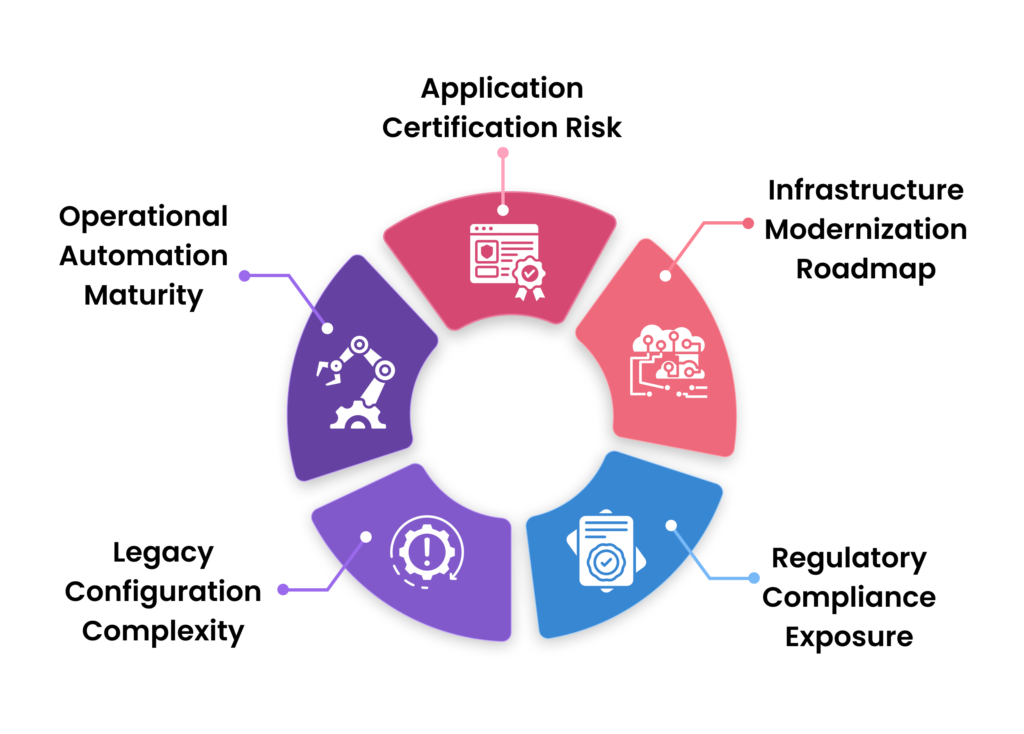
The strongest RHEL 7 to 9 migration outcomes happen when the migration supports a broader infrastructure strategy instead of being rushed due to lifecycle deadlines.
When Should You Upgrade RHEL 7 to 9?
If RHEL 7’s end of life has already passed in your deployment, the real question is not whether migration is necessary.
It is whether you are setting the schedule or responding to external pressure.
Enterprises that proactively upgrade RHEL 7 to 9 often report smoother audits, tighter patch governance, and noticeable security posture improvement within a year.
Those who wait typically deal with compressed migration timelines driven by compliance findings.
There is a clear difference between planned modernization and forced remediation.
Conclusion
RHEL 7 to 9 migration is not just an operating system transition.
It is lifecycle governance.
Remaining on RHEL 7 without a clear roadmap limits modernization capacity over time. Executing a structured RHEL 7 to 9 migration strengthens long-term resilience, improves compliance alignment, and supports operational stability.
Enterprises that approach migration as strategy rather than routine maintenance consistently achieve stronger results.


