Ask any business leader what they compete on, and you will hear the same answers. Better pricing. Stronger product. Bigger marketing budget. All those things matter, but none of them hold up as a lasting advantage the way they used to.
What does hold up is how your customers feel every single time they deal with you. That is Customer Experience (CX). And in 2026, it will be the hardest thing for any competitor to replicate.
The Real Problem Most Businesses Are Ignoring
Modern customers do not give second chances the way they used to. When an interaction feels slow, generic, or disconnected from what they actually need, they move on. The problem is not usually that businesses do not care. It is that their systems are not set up to deliver consistency on a scale.
The friction points that silently drive customers away:
- Inconsistent experiences across mobile, web, and support channels
- Support teams working without full context on the customer's history
- Long response times because agents have to juggle multiple disconnected tools
- Interactions that feel scripted rather than relevant to the individual
- No clear path for a customer to get help quickly without repeating themselves
These are not edge cases. They are standard operating conditions for most mid-market and enterprise businesses that have not yet invested in connected CX infrastructure.
"Every touchpoint is either building trust or eroding it. There is no neutral interaction."
Ekfrazo Technologies
What Makes Customer Experience a True Competitive Moat
It Cannot Be Copied on a Roadmap
A competitor can match your pricing in a week. They can ship a similar feature in a quarter. What they cannot do quickly is replicate the culture, the connected data, intelligent workflows, and frontline habits that make your customer experience consistently good.
That is what makes CX a moat. Not the experience itself in any single moment, but the organizational capability behind it. When a business has that working, the results compound over time in ways that are genuinely difficult to close the gap on.
The Three Things That Make CX Stick
- Consistency across every channel – A customer who has a great mobile interaction and then a frustrating support call does not average the two. They remember the friction. Consistency is what builds trust, not individual highlights.
- Speed that matches what customers expect – Slow support is not a minor issue. It is a signal to the customer that their time is not a priority. When AI-assisted tools handle routine issues instantly, human agents can focus on the conversations that actually need judgment.
- Relevance at every touchpoint – Generic responses and copy-paste replies tell a customer that your team does not know them. Context-aware interactions, backed by real customer data, change that entirely.
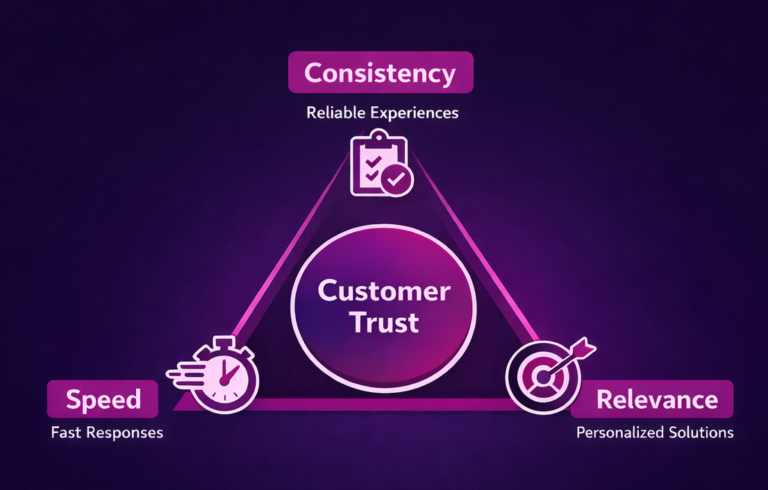
"The CX Moat Framework"
How Ekfrazo Approaches CX Differently
Ekfrazo does not treat customer experience as a single product or a one-size deployment. The work starts with understanding where the actual friction lives in a business, then building the right combination of AI, automation, and platform capability to fix it in a way that holds up.
AI-Powered Engagement That Feels Human
The biggest shift in CX delivery over the past two years is not chatbots. It is context-aware AI that actually understands what a customer needs and responds accordingly.
Ekfrazo’s AI-driven customer experience solutions include voice assistants and AI agents built to handle real conversations, not just scripted decision trees. They engage customers instantly, understand context, and route to human agents only when the situation genuinely calls for it.
What this means in practice:
- Lower first-response times without adding headcount
- Higher resolution rates on first contact
- Consistent tone and accuracy across thousands of simultaneous interactions
- Customer data captured at every step to improve future interactions
Real-Time Intelligence for Marketing and Sales Teams
Good CX is not just about support. It starts much earlier, at the point where a prospect first interacts with a brand.
Ekfrazo builds real-time AI dashboards that give marketing and sales leaders actual visibility into what customers are doing, what they respond to, and where they drop off. That intelligence feeds directly into campaign decisions, content priorities, and conversion optimization without the usual lag between data collection and action.
The Role of Salesforce and Oracle in Connected CX
For enterprise clients, delivering consistent CX across channels requires the right platform infrastructure underneath it. Ekfrazo’s work with Salesforce CRM and Oracle Cloud solutions connects sales, support, and operations data into a single customer view. That is what makes personalization possible rather than theoretical.
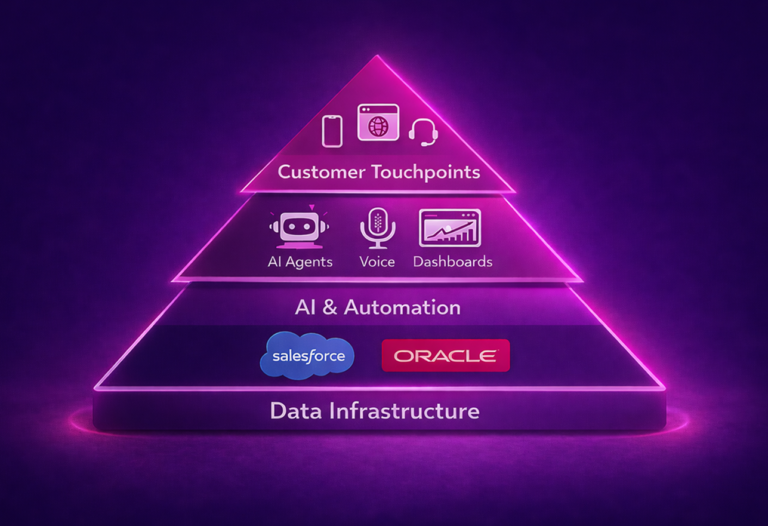
"Ekfrazo's CX Stack"
Employee Experience Is What Delivers CX at the Frontline
This connection gets skipped over in most CX conversations. But it is foundational.
Your customer experience is only as good as the experience your employees are having when they try to deliver it. When frontline teams are working with fragmented tools, they have no clear escalation path, and lack the authority to resolve issues without going through layers of approval, that friction reaching the customer.
Ekfrazo’s approach to employee experience solutions treats EX as infrastructure for CX delivery. When employees can act quickly, with full context and the right tools, customer interactions are faster, more accurate, and genuinely more helpful.
Streamlining Internal Operations Through ServiceNow
One of the most common blockers to great CX is slow internal operation. When an agent has to email three people to find an answer, that delay is the customer’s problem too.
Ekfrazo’s ServiceNow consulting practice helps businesses redesign internal workflows so that resolution paths are clear, fast, and do not rely on tribal knowledge. The outcome is fewer escalations, lower handle times, and a team that can actually focus on the customer rather than the process.
What Operational Experience Has to Do With CX
Operational experience is the third piece of Ekfrazo’s model, and it connects directly to what customers receive. When IT, logistics, finance, and compliance functions are running on intelligent, automated systems, the downstream effect is a business that responds faster and makes fewer errors in customer-facing processes.
For industries like telecom and manufacturing, where operational complexity is high and customer tolerance for delays is low, this connection is especially important to get right.
The Business Case for Investing in CX Now
What CX Actually Costs When It Goes Wrong
Businesses often look at CX investment as a cost. The more useful way to look at it is through the cost of not investing.
What poor CX costs a business
- Higher churn rates that require constant replacement of lost revenue
- Increased cost per acquisition as referral rates drop
- More support volume as unresolved issues return repeatedly
- Negative reviews that affect pipeline quality before prospects even talk to sales
- Higher agent turnover because working with bad tools is exhausting
A Simple Retention Economics Calculation
Work out your average customer contract value. Multiply it by your current annual churn rate. That number is what you are losing each year to experience failures. Now estimate what recovering even 10 to 15% of that churn would mean in revenue terms.
For most businesses, the result of that calculation changes the internal conversation about CX investment significantly.
Protecting the Digital Experience End-to-End
A strong CX strategy also depends on the digital infrastructure behind it being reliable and secure. Slow portals, broken integrations, or a security incident can undo months of trust-building in a single event.
Ekfrazo’s cybersecurity services protect the digital channels that customers interact with, so that the experience remains consistent and trustworthy even as usage scales.
Checklist: Is Your Business Ready to Build a CX Moat?
Use this to identify where your gaps are before you invest in the wrong place.
- Do your customers get a consistent experience across every channel you operate?
- Can your support team see a customer's full history before they start a conversation?
- Are routine customer issues being resolved without needing a human agent every time?
- Do your frontline employees have clear processes and the tools to act on them?
- Are your internal workflows fast enough that delays do not reach the customer?
- Is your customer data connected across sales, support, and operations?
- Do you have real-time visibility into where customers are dropping off or disengaging?
If you answered no to three or more of these, the gap between your current CX and a genuine competitive moat is significant. The good news is that each of those gaps has a clear fix.
FAQs
What is a CX moat and why does it matter in 2026?
A CX moat is a level of customer experience so consistently good that competitors cannot easily match it. It is built through connected data, AI-assisted delivery, and internal processes that remove friction at every stage. In 2026, with lower switching costs and higher buyer expectations, it is the most durable advantage a business can hold.
How does Ekfrazo build CX solutions for enterprise businesses?
Ekfrazo combines AI agent technology, platform expertise across Salesforce, Oracle, and ServiceNow, and deep work on internal operations to build CX delivery that works at scale. The approach starts with identifying where friction actually lives in a business, not applying a generic template.
What industries does Ekfrazo serve with CX solutions?
Ekfrazo works across telecom, manufacturing, financial services, and other enterprise sectors where the volume of customer interactions is high and the cost of poor experience is significant. You can explore industry-specific work here.
How does employee experience connect to customer outcomes?
When frontline employees have the right tools, clear workflows, and the authority to resolve issues without unnecessary steps, customer interactions are faster and more effective. Ekfrazo’s EX work is designed specifically to reduce the internal friction that slows down customer-facing teams.
The Decision That Separates CX Leaders From Everyone Else
The businesses that will look back at 2026 as a turning point are not the ones that launched a new satisfaction survey. They are the ones that made a real commitment to building experience as a strategic capability, backed by the right technology and the right partner.
Ekfrazo works with enterprise and mid-market businesses to build CX that holds up in practice, not just on a dashboard. From AI agents and real-time intelligence to platform integration and operational redesign, the work is built around outcomes that show up in retention, referral, and revenue.
Talk to the Ekfrazo team about where your CX gaps are and what it would take to close them. Or read more insights on the Ekfrazo blog including how AI is reshaping customer retention strategy for enterprise growth.