What You Will Know After Reading This
- Why RAG with secure vector embeddings costs about 10x less than fine-tuning for 80%+ of enterprise use cases
- How vector database memory scales: 2M chunks at 1,536 dimensions need roughly 18–20 GB with an HNSW index
- The token math for 500,000 monthly queries, line by line, including semantic caching savings
- A 5-stage, 8–16 week roadmap from data audit to production FinOps
- A simple ROI model that shows payback timing before you sign an SOW
Table of Contents
- The Core Enterprise Reality: Why Most AI Proof-of-Concepts Die Before Production
- Enterprise AI Implementation Cost Matrix and AI Project Budget Scenario Math
- Visual Architecture: The Enterprise AI Pipeline
- The Ekfrazo 5-Stage Enterprise AI Implementation Roadmap
- Where AI Projects Fail: Hidden Token Drift and Data Silo Traps
- Qualification Matrix: When to Build Custom RAG vs. When to Buy SaaS AI
- How Ekfrazo Delivers Secure, High-ROI Enterprise AI Consulting
- Frequently Asked Questions
The Core Enterprise Reality: Why Most AI Proof-of-Concepts Die Before Production
Most enterprise AI proofs-of-concept stall because the demo skips the 70% of enterprise AI implementation cost that sits in data cleansing, retrieval pipelines, orchestration, and security guardrails rather than model tokens.
Any developer can connect a chat UI to a hosted LLM over a weekend. Executives see it answer five handpicked questions and approve a budget.
Then production happens. The assistant has to respect SharePoint permissions. It has to answer from 400,000 PDFs, half of them scanned. It has to stay under a cost-per-query ceiling and refuse to invent a refund policy. The weekend prototype has none of that, and rebuilding it properly costs far more than the original estimate.
The gap is engineering, not model choice. Teams that budget only for API tokens underestimate Year-1 spend by roughly 3x.
Planning an Enterprise AI Rollout or RAG Pipeline? Stop guessing infrastructure requirements—Discuss an enterprise AI project with Ekfrazo’s senior AI architects.
Enterprise AI Implementation Cost Matrix and AI Project Budget Scenario Math
For a mid-market enterprise, API-driven RAG typically lands between $180K and $450K in Year-1 TCO, while custom fine-tuning programs run $1.5M or more once GPU compute and MLOps are counted.
| AI Architecture Approach | Year-1 TCO Range* | Latency / Accuracy Profile | Best Enterprise Use Case |
|---|---|---|---|
| API-driven RAG (managed LLM + vector DB) | $180K–$450K | 1.5–3 s p95; grounded, cited answers; accuracy tracks retrieval quality | Knowledge search, support copilots, policy Q&A |
| Hybrid private LLM (open-weight model on L40S/H100 + RAG) | $450K–$1.1M | 0.8–2.5 s p95 once tuned; full data residency; needs GPU capacity planning | Regulated data, residency mandates, high steady volume |
| Dedicated fine-tuning / custom model | $1.5M–$4M+ | Fast on narrow tasks; knowledge goes stale without retraining; catastrophic forgetting risk | Specialized output formats, domain extraction, clinical or legal coding |
*Ekfrazo planning ranges for 2026, including people, infrastructure, and Year-1 operations.
RAG wins most evaluations for one reason. You update knowledge by re-indexing documents, not retraining weights. No forgetting, no GPU training runs, and every answer traces back to a source chunk.
Scenario: 500,000 Monthly Support Queries and Document Searches
Assumptions (illustrative rates; actual pricing varies by provider, model tier, and contract, so plug in your own):
- Input per query: 2,600 tokens (800 system and guardrail instructions, 1,600 retrieved context from 4 chunks × 400 tokens, 200 user query and history)
- Output per query: 350 tokens
- Illustrative mid-tier API rate: $2.50 per million input tokens, $10 per million output tokens
Token math:
- Input: 500,000 × 2,600 = 1.3B tokens/month → $3,250
- Output: 500,000 × 350 = 175M tokens/month → $1,750
- Raw monthly spend: $5,000
- With a 30% semantic cache hit rate: ~$3,500/month (~$42K/year)
Vector math: 2M chunks × 1,536 dimensions × 4 bytes ≈ 12.3 GB of raw vectors. HNSW indexing and metadata push that to 18–20 GB of memory. Embedding the full corpus once (800M tokens at an illustrative $0.02 per million) costs about $16. Embeddings are cheap. Re-embedding pipelines and the engineering time behind them are not.
| Cost Layer | Year-1 Estimate | Share |
|---|---|---|
| LLM tokens (cached) + evaluation traffic | $50K | 23% |
| Vector DB, embeddings, hosting | $15K | 7% |
| Data cleansing and ingestion pipelines | $45K | 21% |
| LangGraph/MCP orchestration and integration | $50K | 23% |
| Security guardrails and red-teaming | $30K | 14% |
| Observability, evals, FinOps, internal overhead | $25K | 12% |
| Total AI project budget | $215K | 100% |
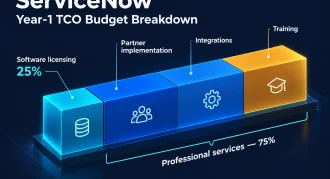
The model and infrastructure layer comes to $65K, almost exactly 30% of spend. The other 70% is the work that makes the system safe to switch on.
Visual Architecture: The Enterprise AI Pipeline
A production enterprise AI pipeline has six layers, and access control has to be enforced at the retrieval layer. Enforcing it only in the user interface leaves restricted data exposed.
[Enterprise Data Sources: Docs, SQL, APIs]
              |
              v
[Chunking & Vector Embedding Pipeline]  -- PII redaction, ACL tagging
              |
              v
[Secure Vector DB: PGVector / Qdrant]   -- metadata filters by user group
              |
              v
[LangGraph / MCP Orchestration]         -- tool calls, step caps, semantic cache
              |
              v
[LLM Engine: Private or API]            -- token budgets per request
              |
              v
[Guardrails & UI]                       -- grounding checks, audit logs
For a deeper treatment of retrieval design, see our guide to RAG architecture for enterprise LLMs.
The Ekfrazo 5-Stage Enterprise AI Implementation Roadmap
A production-grade AI implementation roadmap runs 8 to 16 weeks across five gated phases, each closing only when data privacy boundaries, retrieval accuracy, and cost-per-query targets are measured and signed off.
Phase 1: Data Readiness, Security Boundaries, and Privacy Auditing (Weeks 1–3)
Inventory every source the assistant may touch. Classify data by sensitivity, map access groups from your identity provider, and decide what never enters an index. Expect this phase to surface duplicate, outdated, and conflicting documents. Fixing them now prevents confident wrong answers later.
Phase 2: RAG Pipeline Design, Chunking Strategies, and Vector DB Selection (Weeks 3–6)
Pick an embedding model (text-embedding-3 or an open-source equivalent such as BGE or E5) and test chunk sizes against real queries. Structure-aware chunking with 10–15% overlap usually beats fixed splits. PGVector suits teams already on Postgres under ~10M vectors. Qdrant or Pinecone fit larger or more filter-heavy workloads.
Phase 3: Agentic Orchestration, MCP Integration, and Tool Calling (Weeks 5–9)
LangGraph handles stateful, multi-step workflows with explicit control over each node. Model Context Protocol (MCP) standardizes how the model reaches ERP, CRM, and ticketing tools, so integrations stay reusable instead of hardcoded.
Phase 4: Hallucination Guardrails, Red-Teaming, and Latency Optimization (Weeks 8–12)
Run adversarial prompts for jailbreaks, prompt injection through documents, and cross-tenant leakage. Add grounding checks that block answers without supporting citations. Tune re-ranking and streaming until p95 latency meets the target.
Phase 5: Production Deployment, Token FinOps, and Continuous Evaluation (Weeks 11–16)
Ship with per-team cost dashboards, semantic caching, and model routing that sends simple queries to cheaper models. A golden evaluation set of 300–500 real questions runs on every prompt or model change.
Where AI Projects Fail: Hidden Token Drift and Data Silo Traps
Most AI budget overruns trace to four patterns: naive document chunking, uncapped agentic loops, missing retrieval-layer access controls, and prompt token drift, which together can double monthly LLM spend within one quarter.
1. Chunking without overlap or structure. Fixed 512-token splits cut tables and contract clauses in half. Retrieval returns fragments, and the model fills the gaps with guesses.
2. Runaway agentic loops. Each agent step resends the full context. A six-step loop over 3,000 tokens of context consumes 18,000+ input tokens, about 7x a single pass. Cap steps and enforce token budgets inside the LangGraph state.
3. Access control in the UI only. If HR salary files and board financials share an index with general policies, any clever prompt can surface them. Filter by ACL metadata at query time, synced to Entra ID or Okta groups.
4. Prompt token drift. System prompts grow quietly from 800 to 3,000 tokens over a few sprints. At 500,000 queries, that adds 1.1B input tokens a month, about $2,750 at the illustrative rate, with no one approving it.
3 Architecture Questions to Ask AI Vendors Before Signing an SOW
- Where are access controls enforced: at retrieval, or only in the interface?
- What is the projected cost per 1,000 queries, and what happens to it when context doubles?
- Can we swap the LLM or embedding model without rebuilding the pipeline, and who owns the evaluation dataset?
Qualification Matrix: When to Build Custom RAG vs. When to Buy SaaS AI
Build custom RAG when proprietary data, multi-system tool calling, or regulatory audit trails are involved; buy SaaS AI when the use case is generic, low-risk, and needs live users within 30 days.
Build Custom RAG / Agentic Systems If:
- Your answers depend on proprietary data that cannot leave your cloud tenancy or region
- The assistant must act across internal tools (ERP updates, ticket routing, approvals) through MCP or APIs
- Compliance demands full audit logs, data residency, and documented model governance
Buy Off-the-Shelf SaaS AI If:
- The use case is generic FAQ deflection on public-facing content
- No sensitive internal systems or restricted documents are involved
- Speed to market matters more than differentiation, and the vendor’s roadmap fits yours
Many enterprises run both: SaaS for website FAQs, custom RAG for internal knowledge. Our work on AI chatbot automation and cloud deployment often starts with exactly that split.
How Ekfrazo Delivers Secure, High-ROI Enterprise AI Consulting
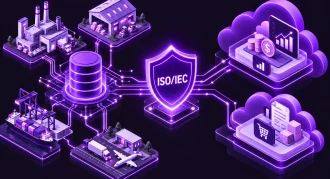
Ekfrazo’s enterprise AI consulting ties every deployment to a measurable CX, EX, or OX outcome, governed by ISO/IEC 42001 and ISO/IEC 27001-certified management systems, so ROI is tracked from week one.
We connect three layers. CX: support copilots that cut handling time. EX: internal knowledge assistants that end the hunt across SharePoint, Confluence, and shared drives. OX: agentic workflows that move approvals and data entry without manual handoffs.
ROI model, using the scenario above: suppose 100,000 of the 500,000 monthly queries are support tickets. A 25% resolution rate without escalation, at $3 per handled ticket, saves about $75,000 a month. Against a $215K Year-1 budget, payback lands around month three. Halve the resolution rate and it still lands inside two quarters.
Every engagement ships with documented data lineage, access policies, and an evaluation baseline your auditors can read. Explore our full enterprise AI consulting and development services.
Get a Defensible Year-1 AI Budget Before You Commit
Bring your use case, data sources, and query volumes. Ekfrazo’s architects will map the right approach (RAG, hybrid, or fine-tuned), model your token and infrastructure costs, and outline an 8–16 week path to production.
Frequently Asked Questions
These five answers cover the questions CTOs and CIOs ask most often about enterprise AI implementation cost, consulting scope, and roadmap timing, using Ekfrazo’s 2026 planning ranges.
How much does enterprise AI implementation cost in 2026?
Most mid-market API-driven RAG deployments cost $180K–$450K in Year 1. Hybrid private LLM setups run $450K–$1.1M, and custom fine-tuning programs often exceed $1.5M once GPU compute, MLOps, and retraining are included.
Is RAG cheaper than fine-tuning for enterprise AI?
Yes, for 80%+ of enterprise use cases. RAG with a vector database delivers roughly 10x lower TCO than training or fine-tuning custom models, avoids catastrophic forgetting, and updates knowledge by re-indexing documents instead of retraining.
What percentage of an AI project budget goes to LLM tokens?
Model tokens or GPU hosting typically account for about 30% of spend. The remaining 70% covers data cleansing, embedding pipelines, LangGraph or MCP orchestration, security guardrails, evaluation, and internal engineering time.
What does enterprise AI consulting include?
Enterprise AI consulting should cover data readiness audits, architecture selection, RAG pipeline and vector database design, agentic orchestration, red-teaming, guardrails, and token FinOps, plus governance documentation aligned to ISO/IEC standards.
How long does an AI implementation roadmap take from pilot to production?
A well-scoped AI implementation roadmap takes 8 to 16 weeks across five phases: data readiness, RAG design, orchestration, guardrails and red-teaming, and production deployment with continuous evaluation.