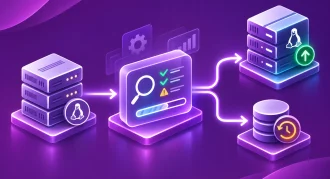
A practical DPDP Act compliance checklist for 2027 comes down to 25 controls across five phases (data discovery, notice and consent, rights and retention, security and breach response, and governance), each with a named owner and a piece of evidence that proves the control works. If all 25 are running inside your production systems before the substantive obligations of the DPDP Rules take effect in mid-May 2027, you are audit-ready; if they exist only in a policy document, you are not.
This guide gives you that checklist in a format your CIO, DPO and engineering leads can split up and track. It is vendor-neutral and written for mid-sized Indian enterprises. If you need a team to build the controls rather than just describe them, our DPDP compliance services cover consent records, rights-request workflows and automated deletion jobs inside your existing applications.
Why 2027 Is the Deadline That Matters
The Digital Personal Data Protection Act, 2023 became operational when MeitY notified the DPDP Rules on 13 November 2025. The Rules come into force in three stages:
- November 2025In forceThe Data Protection Board of India and its procedures took effect.
- November 2026Live nowThe registration framework for Consent Managers came into force.
- Mid-May 2027DeadlineThe core obligations apply, 18 months after notification. These cover notices, consent, security safeguards, breach reporting, retention and erasure, children’s data, Data Principal rights, and the extra duties of Significant Data Fiduciaries (SDFs).
In early 2026, MeitY consulted industry on shortening the 18-month window for some obligations, especially for SDFs. Check the latest Gazette notification before you fix internal dates. In practice, plan as if the deadline could come sooner.
The penalties are why boards are paying attention. Under the Schedule to the Act, failing to take reasonable security safeguards to prevent a personal data breach can cost up to ₹250 crore per instance. Failing to notify a breach, or failing to meet the obligations for children’s data, can cost up to ₹200 crore each.
The Board will judge you on what you can show, not on what you intended.
How to Use This DPDP Act Compliance Checklist
- CheckThe control that must exist.
- OwnerThe single role accountable for it. A shared owner usually means no owner.
- EvidenceThe artefact an auditor or the Board would ask to see. Evidence should be generated by the system wherever possible, not written up afterwards.
Assign the owners first, then work through the phases in order. Each phase depends on the one before it: you cannot honour an erasure request for data you have not mapped.
Checks 1–5
Phase 1: Discover and Map
DPDP compliance starts with knowing where personal data lives. Most mid-sized enterprises find personal data in 2–3 times more systems than they expected, including CRM exports, shared drives, analytics tools and old staging databases.
| # | Check | Owner | Evidence |
|---|---|---|---|
| 1 | Personal data inventory covering every application, database, SaaS tool and file share | CIO / Head of IT | Data inventory register with system, data category, location and volume |
| 2 | Data flow maps showing collection points, internal transfers, processors and cross-border flows | Enterprise Architect | Versioned data flow diagrams linked to the inventory |
| 3 | A specified, lawful purpose recorded for every processing activity | DPO / Privacy Lead | Record of processing activities (RoPA) with purpose and legal basis (consent or legitimate use) |
| 4 | Data Processor register with the scope of each processor’s access | Procurement Head | Processor register cross-referenced to signed contracts |
| 5 | SDF self-assessment based on volume, sensitivity and risk criteria | Legal Counsel | Signed assessment memo, reviewed every year |
Run automated discovery scans across structured and unstructured stores rather than relying on survey forms alone. Teams tend to under-report shadow data.
Checks 6–10
Phase 2: Notice and Consent
The Rules require a notice that stands on its own, uses clear language, itemises the personal data being collected and states the specific purpose. Consent must be as easy to withdraw as it was to give. This is an engineering requirement, not just a legal one.
| # | Check | Owner | Evidence |
|---|---|---|---|
| 6 | Standalone, itemised privacy notices at every collection point (web, app, forms, call centre), available in English and Eighth Schedule languages where relevant | DPO + Product Owner | Notice inventory with screenshots per channel and version history |
| 7 | Consent captured granularly by purpose, never bundled with terms of service | Product Owner | Consent UI specification plus test cases showing unbundled options |
| 8 | Immutable consent records storing who, what, when, which notice version and which purposes | Engineering Lead | Consent ledger schema and sample tamper-evident log entries |
| 9 | Consent withdrawal that is as easy as giving consent and stops downstream processing | Engineering Lead | End-to-end test showing withdrawal reaching CRM, marketing and analytics systems |
| 10 | Verifiable parental consent for users under 18, plus no tracking, behavioural monitoring or targeted advertising aimed at children | Product Owner + Legal | Age-gating flow, parental verification logs and ad-tech configuration review |
Consent records are where policy-led programmes usually fail. A checkbox on a form is not evidence. A queryable record linking each Data Principal to a notice version and a purpose is.
Checks 11–15
Phase 3: Data Principal Rights and Retention
Data Principals can request access, correction, completion and erasure. They can also raise grievances and nominate another person to act for them. The Rules give you a maximum of 90 days to resolve a grievance. Retention limits also require you to erase data once its purpose is served.
| # | Check | Owner | Evidence |
|---|---|---|---|
| 11 | Rights-request intake (web form, email, app) with identity verification | Customer Service Head | Intake workflow configuration and identity verification SOP |
| 12 | Rights-request workflow with ticketing, SLA timers and routing to system owners | Engineering Lead | Workflow logs showing request IDs, timestamps and closure within SLA |
| 13 | Nomination mechanism that lets a Data Principal appoint a nominee | DPO | Nomination form, records store and fulfilment test |
| 14 | Retention schedule per data category, mapped to purpose and to sector laws (RBI, IRDAI, Companies Act) | Legal Counsel + DPO | Approved retention matrix referencing statutory periods |
| 15 | Automated deletion jobs, including the 48-hour pre-erasure notice for Third Schedule entities (e-commerce, gaming and social media platforms above the user thresholds) | Engineering Lead | Scheduled job definitions, run logs, deletion certificates and notice dispatch logs |
Deletion has to reach backups, data warehouses and processor copies, or you need a documented exception for each. An erasure that only removes a row from the primary database will not pass an audit.
Checks 16–20
Phase 4: Security Safeguards and Breach Response
This phase carries the highest penalty. Rule 6 sets out baseline safeguards: encryption, obfuscation or masking, access control, logging and monitoring, backups for continuity, and logs kept for at least one year.
| # | Check | Owner | Evidence |
|---|---|---|---|
| 16 | Encryption of personal data at rest and in transit, plus masking or tokenisation in non-production environments | CISO | Encryption standard, key management records and masked test data samples |
| 17 | Role-based access control with least privilege and periodic access reviews | CISO + IAM Lead | Access review reports signed off every quarter |
| 18 | Centralised logging of access to personal data, kept for at least one year | SOC Manager | SIEM retention configuration and sample access-log queries |
| 19 | Breach response plan: notify affected Data Principals without delay, and send the Board an initial intimation followed by a detailed report within 72 hours | CISO + DPO | Incident response plan, notification templates and a tabletop exercise report |
| 20 | Backup, restore and continuity testing for systems holding personal data | IT Infrastructure Head | Restore test results with RTO/RPO evidence |
Run at least one breach simulation before mid-May 2027. The 72-hour clock is tight, and most teams discover during the drill that they cannot quickly identify which Data Principals were affected. That gap traces back to Phase 1.
Checks 21–25
Phase 5: Governance, Vendors and Assurance
The final phase keeps the programme running after go-live and makes it defensible.
| # | Check | Owner | Evidence |
|---|---|---|---|
| 21 | Published business contact for privacy questions (a DPO based in India for SDFs) | CEO / Board | Website contact page and board resolution appointing the DPO |
| 22 | DPDP-specific clauses in every processor contract, covering security, breach notification, deletion on exit and sub-processing | Legal Counsel | Executed contract addenda tracked against the processor register |
| 23 | Annual Data Protection Impact Assessment (DPIA) and independent audit for SDFs, including due diligence on algorithmic software | DPO | DPIA reports, audit report and remediation tracker |
| 24 | Role-based privacy training for engineering, support, marketing and HR | HR Head + DPO | Training completion records and assessment scores |
| 25 | Quarterly compliance dashboard reviewed by leadership | DPO | Dashboard snapshots and minutes of leadership reviews |
A Realistic Six-Month Plan to Mid-May 2027
With roughly six months left, sequence the work as follows:
- December–JanuaryPhase 1 complete. Owners assigned and the inventory signed off.
- February–MarchPhases 2 and 3 built and tested. This is the heaviest engineering lift.
- AprilPhase 4 hardening plus a breach tabletop exercise.
- MayPhase 5 contracts closed, evidence pack assembled, and an internal audit dry run.
The bottleneck is almost never the policy. It is the engineering backlog: integrating consent records into legacy applications, wiring rights requests across many systems and writing deletion jobs that handle dependencies safely.
Where Ekfrazo Fits
Many DPDP programmes stall at the handover from the advisory deck to the sprint backlog. Ekfrazo works on the build side of that gap. Our engineers implement consent ledgers inside your applications, build rights-request workflows that route to every system holding a Data Principal’s data, and write scheduled deletion jobs that produce their own run logs as evidence.
- Consent ledgers
- Rights-request workflows
- Automated deletion jobs
We work alongside your legal counsel or existing privacy advisors. We do not replace them.
Frequently Asked Questions
When do DPDP Act obligations become enforceable?
The Board has been operational since November 2025 and Consent Manager registration since November 2026. The core obligations for Data Fiduciaries, including notice, consent, security, breach reporting, rights and retention, apply from mid-May 2027, 18 months after the Rules were notified. MeitY has consulted on shortening some timelines, so track Gazette updates.
What is the maximum penalty under the DPDP Act?
The highest penalty is up to ₹250 crore per instance, for failing to take reasonable security safeguards to prevent a personal data breach. Breach notification failures and children’s data violations can each attract up to ₹200 crore.
Does the DPDP Act apply to B2B companies that only hold employee and vendor contact data?
Yes. Employee records, vendor contacts and B2B customer contacts are all digital personal data. Some employment-related processing may qualify as a “legitimate use”, but notice, security, retention and rights obligations still apply.
How fast must a breach be reported under DPDP compliance rules?
Affected Data Principals and the Data Protection Board must be told without delay. A detailed report must reach the Board within 72 hours of the Data Fiduciary becoming aware of the breach, unless the Board allows longer.
What does “audit-ready” mean for DPDP compliance?
It means every control has a named owner and evidence generated by the system, such as consent logs, workflow SLA records, deletion run logs and access reviews. With that in place, you can show compliance on demand instead of reconstructing it after a complaint.
Turn the Checklist Into Working Controls
A DPDP Act compliance checklist only protects you once each check is a running control with evidence behind it. If your team has the policies but not the engineering capacity to build consent records, rights-request workflows and deletion jobs before mid-May 2027, talk to us about our DPDP compliance services. We will map your gaps against these 25 checks and build the controls inside the systems you already run.