Enterprises evaluating modernization options often reach a critical point: continue investing in an aging legacy ERP, or modernize into Oracle Fusion Cloud. While legacy ERP platforms may offer stability and predictability, they increasingly limit scalability, security, agility, and integration with modern tools.
Organizations facing slow reporting, outdated security, rising integration overhead, or hardware nearing end-of-life often ask: Is my legacy ERP slowing down innovation, and is it time to shift to Oracle Fusion Cloud?
Oracle Fusion Cloud provides a unified, cloud-native suite built on OCI. It supports finance, HR, supply chain, procurement, and analytics — a modern environment trusted by leading enterprises and supported by experienced digital transformation experts.
Below is a structured breakdown that helps enterprises compare, evaluate, and plan modernization.
What Problems Do Legacy ERP Systems Create?
Legacy ERPs (EBS, PeopleSoft, JD Edwards, homegrown systems) were not built for today’s cloud-native requirements. As enterprises scale globally or adopt modern SaaS tools, older ERP systems begin showing critical limitations:
- Increasing downtime during patch cycles
- High dependency on custom code that becomes expensive and brittle
- Slow integrations with SaaS applications
- Security vulnerabilities due to outdated IAM models
- Infrastructure costs rising as hardware reaches end-of-life
In many cases, the maintenance overhead of legacy ERP environments exceeds the modernization investment — especially when compliance, security, and integration needs accelerate.
This is why CIOs increasingly evaluate modernization through Oracle ERP Cloud Services rather than continuing legacy IT investment.
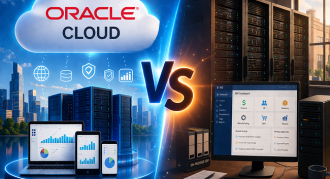
Oracle Fusion Cloud vs Legacy ERP Systems: Key Differences
Below is a simplified comparison to help enterprises evaluate the modernization path toward Oracle Fusion Cloud and Oracle ERP Cloud.
| Dimension | Oracle Fusion Cloud | Legacy ERP Systems |
| Architecture | Cloud-native design running on Oracle Cloud Infrastructure (OCI), with modular services and a unified data model | On-premises or hosted, monolithic or semi-modular, often with custom integrations and inconsistent data models |
| Updates & Maintenance | Automatic and frequent updates, continuous feature releases, minimal downtime | Manual updates, scheduled patches, costly testing cycles, high risk of service disruption |
| Scalability | Elastic compute (VMs, bare metal, containers), auto-scaling, global region support | Vertical scaling on the same hardware, fixed capacity, limited global reach, high capital expenditure |
| Performance | High throughput, low latency, optimized for large Oracle databases, built-in caching, and fast networking | Dependent on local hardware, performance constraints, network bottlenecks, and limited elasticity |
| Integration | Native integration with SaaS systems (Salesforce, SAP, Workday) via Oracle Integration Cloud, API-first architecture | Custom-coded connectors, batch-based data transfers, long development cycles to integrate with modern cloud tools |
| Security & Compliance | Built-in IAM, centralized policy management, encryption, audit logging, Cloud Guard / Vault | On-prem IAM, manual policy enforcement, limited real-time visibility, and a greater risk of misconfiguration |
| Cost Model | Predictable subscription, pay-for-use, no hardware maintenance, reduced IT headcount | Large CapEx, ongoing server maintenance, license renewals, high cost for upgrades and integrations |
| Modernization Options | Supports rehost, refactor, rearchitect, or replacement to Fusion Cloud modules (ERP, HCM, SCM) | Frequently limited to custom patching or gradual upgrades, legacy custom code remains costly and risky to replace |
| Business Agility | Rapid deployment of new features, business process automation, integration with AI/analytics | Slow release cycles, limited flexibility, high dependency on legacy customizations, and time-consuming development |
| Backup & Recovery | Built-in autonomous backup, region redundancy, and disaster recovery via OCI | Legacy backup solutions, manual DR processes, and recovery time depend on hardware and network |
This comparison highlights why organizations moving toward digital transformation increasingly prefer Oracle Fusion Cloud.
What Do These Differences Mean for Your Business?
- Lower Risk, Higher Business Agility: Fusion Cloud offers continuous updates, automated compliance, and AI-powered workflows — driving rapid adaptability compared to legacy ERP.
- Reduced Total Cost of Ownership: Subscription-based pricing, infrastructure offloading, and reduced maintenance deliver long-term savings.
- Better Integration: Built-in connectors and automation through Oracle Integration Cloud close gaps between finance, HR, SCM, and procurement.
- Global Scalability on OCI: Enterprises experiencing rapid growth or needing global reach benefit from the elastic, high-performance architecture of OCI.
- Improved Governance and Security: With centralized Identity and Access Management, cloud-native encryption, and audit tools, compliance and policy enforcement become more manageable.
When Should Enterprises Switch to Oracle Fusion Cloud
Organizations should consider migrating when:
- Reporting performance becomes slow
- Integration costs increase
- Security infrastructure becomes outdated
- Hardware reaches end-of-life
- Compliance requirements tighten
- Global expansion requires scalable cloud systems
- Business units need automation and AI-driven insights
If any of these are true, continuing legacy ERP investment becomes riskier than adopting Oracle Fusion Cloud.
Questions Enterprises Commonly Ask Before Migrating
How does Oracle Fusion Cloud improve scalability?
Fusion Cloud runs on Oracle Cloud Infrastructure, which supports elastic compute, autoscaling, and high availability across multiple regions.
Will our custom integrations still work?
Using Oracle Integration Cloud, most enterprises create faster, more stable integrations than they had in legacy ERP environments.
Can we migrate without disrupting business operations?
A phased migration, beginning with non-critical modules or analytics workloads, ensures business continuity while gradually transitioning off the legacy stack.
Is the cost justified for mid-sized organizations?
Yes, because reduced maintenance, automated updates, and lower hardware requirements offset long-term support and licensing expenses.
How Ekfrazo Supports Fusion Cloud Transformations
Ekfrazo provides end to end consulting and implementation services for:
- Oracle ERP Cloud modernization
- Oracle HCM Cloud transformation
- Oracle SCM Cloud deployment
- Data migration and integration
- Oracle Cloud Infrastructure setup
- Legacy ERP to Fusion Cloud migration
- Continuous support and optimization
Explore the expertise behind successful transformations by meeting the Oracle consulting team.
To discuss your modernization roadmap, connect with the Fusion Cloud migration experts.
Or return to the digital transformation experts homepage to explore more capabilities.