Published: 26 November 2026 | Updated: 26 November 2026
By Shash Kandel, Infrastructure Architect, Ekfrazo Technologies — designs hybrid virtualisation, Red Hat OpenShift and Ansible automation programmes for enterprise estates.
Since Broadcom moved VMware from perpetual, à-la-carte licensing to subscription bundles, many enterprise customers have reported a steep VMware price increase at renewal, in some publicly cited cases several times what they paid before. The right first move is to measure your actual exposure 12–36 months ahead of renewal, and only then decide whether to stay, optimise, or migrate.
That order matters. A renewal quote is a single number; exposure is the full picture: which bundle you are being moved into, how many hosts and cores you license versus actually use, and how much runway you have before the contract ends. Organisations that start with a VMware renewal-exposure check negotiate from facts rather than deadlines, and avoid both overpaying and rushing into an under-planned migration.
This guide covers what changed, what customers report, what is realistic for your renewal timeline, and the five questions to answer before you sign.
What Changed After the Broadcom Acquisition
Broadcom completed its acquisition of VMware in November 2023 and quickly restructured how the portfolio is sold. Three changes drive most of the Broadcom VMware price increase that customers describe:
- Perpetual to subscription. New perpetual licences were discontinued. Customers now pay a recurring subscription that bundles software entitlement and support for a fixed term.
- À-la-carte to bundles. A large catalogue of individually priced products was consolidated into a small number of bundled offerings, such as VMware Cloud Foundation and vSphere Foundation. Capabilities that customers previously bought separately, or did not buy at all, are now packaged together.
- Per-core licensing. Pricing moved to a per-core metric, so the number and density of CPU cores in your hosts directly shapes the cost.
Why renewal impact varies so widely
Two organisations of similar size can receive very different quotes. The outcome typically depends on:
- The edition you held before. Customers on entry-level vSphere editions who are moved into a broader bundle often see the sharpest jump, because they are now paying for capabilities they never licensed.
- The bundle offered at renewal. What is available to you, and what is bundled in, shapes the price more than your VM count alone.
- Estate size and host design. Core counts, host counts, and consolidation ratios all feed the per-core calculation.
- Term length and route to market. Buying direct, through a partner, or via a cloud provider, and committing for one year or several, all change the final figure.
Licensing terms continue to evolve, so we deliberately avoid quoting specific minimums here. Always validate the rules against your own quote and contract.
What Enterprise Customers Report
Two years after the acquisition, the market picture is clearer. Very few organisations have exited outright, but most are actively reducing their dependence on VMware.
| Reported finding | Source | What it signals |
|---|---|---|
| 86% of VMware customers reported reducing their VMware usage two years after the acquisition | CloudBolt survey | Most organisations are shrinking their footprint rather than simply absorbing the cost |
| A 4x renewal increase was reported by MSIG Asia, which then moved around 2,000 VMs to Nutanix | Public customer case | Large estates can and do execute migrations when the economics shift sharply |
| About 4% reported having fully left VMware, while just over half reported moving in phases | Everywan analysis | Phased, hybrid exits are the dominant pattern; full exits remain the exception |
Disclaimer: Figures above are reported by third-party vendors and analysts and have not been independently verified by Ekfrazo Technologies.
Treat these numbers as market signals, not benchmarks. Several sources sell alternative platforms or tooling, and your own exposure depends entirely on your edition, bundle, estate, and contract position.
What to Do Based on Your Renewal Timeline
Your options narrow sharply as renewal approaches. Here is what is realistic in each window.
| Time to renewal | What is realistic | What to avoid |
|---|---|---|
| Under 6 months | Build an accurate inventory of hosts, cores, VMs, and editions. Right-size and decommission idle VMs and hosts before counts are locked in. Negotiate scope and the shortest workable term to buy time. Start shortlisting migration candidates. | Attempting a full platform migration under deadline pressure. Signing a long multi-year term before you understand your exposure. |
| 6–12 months | Everything above, plus a Dev/Test pilot on one or two alternative platforms. Move low-risk, non-production workloads in a first migration wave. Use pilot results to support a reduced-scope renewal. | Moving production or tightly coupled systems before the pilot has proven backup, DR, monitoring, and rollback. |
| 12–36 months | A full total-cost comparison across stay, hybrid, and migrate. Align the exit with hardware refresh and data-centre contract cycles. Plan migration waves with agreed maintenance windows and tested rollback plans. Retrain operations teams. Execute a phased or full migration. | Letting the window close without a decision. An unused 24-month runway quietly becomes a 6-month emergency. |
The 12–36 month window is where you have the most leverage, both with Broadcom and with alternative vendors. If you are already inside six months, the priority is to reduce what you license now and secure enough time to make a properly planned decision at the next cycle.
Your 3 Strategic Moves: Stay & Optimise, Hybrid/Phased Exit, or Full Migration
Every response to a VMware price increase fits one of three strategic moves. Within them sit seven realistic options.
Move 1: Stay & Optimise
This suits estates where VMware is deeply embedded (heavy use of NSX, vSAN, or vSphere-specific automation) or where renewal is too close for a credible alternative.
- Right-size and consolidate. Reclaim idle and oversized VMs, retire under-used hosts, and redesign clusters so that licensed core counts reflect real demand rather than historical over-provisioning.
- Renegotiate scope and term. Confirm you are being quoted the right bundle, challenge components you do not need, and align term length with your refresh or exit plan rather than defaulting to the longest commitment.
Move 2: Hybrid / Phased Exit
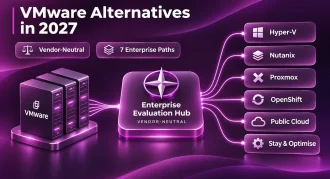
This is the most common path customers report. You keep VMware for the workloads where it earns its cost and move the rest in planned waves. Our guide to VMware alternatives in 2027 compares the leading platforms in detail; in summary:
- Microsoft Hyper-V. A strong fit for Windows-heavy estates already licensed for Windows Server Datacenter. Our VMware to Hyper-V migration plan walks through assessment, conversion, and cutover.
- Nutanix AHV. A hyperconverged platform with mature migration tooling, suited to organisations that want a full-stack replacement with a familiar operational model.
- Proxmox VE. An open-source, KVM-based platform with low licensing cost. It works well for Dev/Test, edge, and cost-sensitive workloads where in-house Linux skills exist.
- Red Hat OpenShift Virtualization. Runs VMs alongside containers on Kubernetes, suited to organisations modernising toward cloud-native operations.
Move 3: Full Migration
- Public cloud or full replatform. Move workloads to Azure, AWS, or Google Cloud, or consolidate entirely onto one alternative hypervisor. Note that hosted VMware services offered by cloud providers remain subject to VMware licensing, so they reduce hardware overhead rather than removing licensing exposure.
Full migration is realistic when you have a 12–36 month runway and a reasonably standardised estate. Whichever move you choose, the method should not change: prove the platform in a Dev/Test pilot, migrate in planned waves, schedule cutovers within agreed maintenance windows, and keep a tested rollback plan for every wave. Any vendor promising a disruption-free or guaranteed-savings migration before seeing your estate is guessing.
The 5 Questions to Answer Before You Sign a Renewal Quote
These five questions mirror the structure of Ekfrazo’s free 30-minute renewal-exposure call. If you cannot answer any one of them with confidence, that is where to start.
- Which edition or bundle do you hold today, and which are you being quoted? The gap between the two often explains most of the increase.
- When exactly does your renewal fall? Confirm the contract end date, notice periods, and any true-up dates, because these define how much time you actually have.
- How many VMs, hosts, and cores do you run? Compare what you license with what you use. Idle capacity is the fastest saving lever available to you.
- What is the quoted renewal figure, and how does it compare to current spend? Normalise both to an annual figure and check exactly what is included in each.
- Who signs off the decision? Identify the CIO, CFO, procurement, and security stakeholders, and the date by which they need a recommendation.
With these answers documented, you can model the cost of staying, optimising, or migrating side by side, and negotiate with evidence rather than urgency.
Frequently Asked Questions
Why did VMware prices increase after Broadcom acquired VMware?
Broadcom moved VMware from perpetual, individually priced products to subscription bundles licensed per core. Customers who previously bought only basic editions are often moved into broader bundles, which is why many have reported significant increases at renewal.
How much has the VMware price increase been for customers?
It varies widely by edition, bundle, estate size, and term. Publicly reported cases include a 4x renewal increase at MSIG Asia. These figures are reported by third parties and are not independently verified by Ekfrazo; your own quote is the only reliable measure.
Can I still buy perpetual VMware licences?
Broadcom has discontinued the sale of new perpetual licences and moved to subscription offerings. If you hold existing perpetual licences, confirm your support and update entitlements with your reseller or Broadcom, as these depend on your contract status.
Should I stay on VMware or migrate to an alternative?
It depends on your renewal timeline, how deeply VMware-specific features are embedded, and your team’s skills. Most customers report a phased approach: optimising what stays on VMware while piloting and gradually moving suitable workloads to alternatives such as Hyper-V, Nutanix, Proxmox, OpenShift, or public cloud.
How long does a VMware migration take, and will it cause downtime?
Timelines range from a few months for small estates to well over a year for large, complex environments. A well-run migration minimises disruption through Dev/Test pilots, planned migration waves, agreed maintenance windows, and tested rollback plans, but some planned downtime during cutover should be expected.
Ready to Measure Your VMware Exposure?
A VMware price increase is far easier to manage when you see it coming. Ekfrazo Technologies is vendor-neutral: we do not sell hypervisor licences, so our only goal is to help you make the right call for your estate, whether that means staying, optimising, or migrating.
Book a free 30-minute VMware renewal-exposure call with an Ekfrazo infrastructure architect. We will walk through your edition, renewal date, VM and core counts, and quoted figure, and give you a clear view of your realistic options. We support enterprises across India, the US, the Middle East, and Africa.