By Arjun Rao, Principal Data Privacy Engineer, Ekfrazo Technologies — CIPP/A
Published: 26 November 2026 | Updated: 26 November 2026
DPDP Act penalties reach up to ₹250 crore per violation, with the ceiling depending on which of five categories in the Schedule to the Digital Personal Data Protection Act, 2023 has been breached, and the Data Protection Board of India sets the actual amount case by case. Core obligations, including security safeguards, breach reporting and children’s data rules, apply from mid-May 2027 (13 May 2027 under the DPDP Rules, 2025).
That leaves less than six months. For most Indian enterprises, the exposure isn’t a missing privacy policy. It’s missing engineering: unencrypted tables, logs nobody keeps, consent that lives in a spreadsheet, and no rehearsed breach process. That’s the gap our DPDP compliance services are built to close.
This guide breaks down each DPDP Act penalty, the technical failures that trigger it, and what the evidence of compliance looks like in production.
Note: The amounts below are statutory maximums under the Schedule to the DPDP Act, 2023. The Data Protection Board decides each penalty case by case after an inquiry. This article explains controls and engineering, not legal advice. Legal interpretation stays with your own counsel.
DPDP Act Penalty Table: Violation by Violation
| Violation Category | Maximum Penalty | What Triggers It | Primary Control Needed |
|---|---|---|---|
| Failure to take reasonable security safeguards to prevent a personal data breach (Section 8(5)) | Up to ₹250 crore | A breach traced to weak controls: plaintext data, over-broad access, no monitoring, unmanaged processors | Encryption, masking or tokenisation; role-based access; logging and monitoring; processor contracts |
| Failure to notify the Board and affected people of a breach (Section 8(6)) | Up to ₹200 crore | Late, incomplete or missing intimation to the Board and affected Data Principals | 72-hour breach SOP, detection-to-notification workflow, pre-approved notice templates |
| Failure to meet obligations for children’s data (Section 9) | Up to ₹200 crore | Processing under-18 data without verifiable parental consent; tracking, behavioural monitoring or targeted ads aimed at children | Age-gating, verifiable parental consent flow, ad and analytics suppression for minors |
| Failure of a Significant Data Fiduciary to meet its extra obligations (Section 10) | Up to ₹150 crore | No India-based DPO, no independent data auditor, missing DPIA or periodic audit | Annual DPIA, independent audit trail, algorithmic due-diligence records |
| Other breaches of the Act or Rules | Up to ₹50 crore | Defective notices, ignored rights requests, over-retention, no grievance redressal | Consent ledger, rights-request workflow, retention and deletion jobs |
Two further Schedule entries exist: individuals who breach their duties as Data Principals can be fined up to ₹10,000, and breaching a voluntary undertaking accepted by the Board can attract the penalty applicable to the original breach. The Act also has no aggregate ceiling, so one incident could, in principle, be examined under more than one heading. How that plays out is a question for your counsel.
Deep Dive: The Top 3 High-Risk Penalties
1. Security safeguards (up to ₹250 crore)
This is the largest DPDP Act penalty, and it’s the one most likely to follow a real incident. Rule 6 of the DPDP Rules spells out what “reasonable security safeguards” should include at minimum:
- Encryption, obfuscation, masking or virtual tokens for personal data
- Access controls on the systems that process it
- Logs, monitoring and review to detect, investigate and fix unauthorised access
- Backups and continuity measures so processing can continue after a compromise
- Retention of logs and relevant personal data for at least one year
- Contract terms requiring Data Processors to maintain safeguards
The technical gaps we see most often:
- Plaintext PII in non-production. Production is encrypted, but UAT and analytics copies hold raw Aadhaar, PAN and phone numbers.
- Shared service accounts. When ten engineers use one database credential, the logs can’t show who accessed what.
- Log retention measured in days. Many SIEM and cloud defaults hold logs for 30 to 90 days, well short of the one-year minimum.
- Vendor blind spots. SaaS tools, BPO partners and marketing platforms process customer data without a DPA or security clause.
Once a breach happens, the Board’s first question is whether these controls existed. A policy document that says “data is encrypted” won’t help if the data warehouse isn’t.
2. Breach notification and the 72-hour window (up to ₹200 crore)
Under Rule 7, a Data Fiduciary that becomes aware of a personal data breach must:
- Inform each affected Data Principal without delay, explaining what happened, the likely consequences, what you’re doing about it, and what they can do to protect themselves.
- Inform the Board without delay with an initial description of the breach.
- Within 72 hours of becoming aware, give the Board a detailed report: facts and cause, mitigation steps, findings on who caused it, remedial measures, and a report on notifications sent to affected people. The Board can allow a longer period on written request.
Why companies miss it: the 72-hour clock starts on awareness, not confirmation. Teams lose the first day deciding whether an alert is “really” a breach, the second finding which customers are affected, and the third arguing over wording. Without a data inventory that maps systems to people and data types, you can’t scope impact fast enough. And without contact data and templates prepared in advance, notifying lakhs of users “without delay” isn’t realistic.
3. Children’s data (up to ₹200 crore)
Section 9 requires verifiable consent from a parent or lawful guardian before processing personal data of anyone under 18. It also bans tracking, behavioural monitoring and targeted advertising directed at children, and any processing likely to harm a child’s well-being. Rule 10 expects you to verify that the person consenting is an identifiable adult, using details you already hold or a virtual token such as one issued through DigiLocker.
Where it breaks in practice:
- A self-declared birth-year dropdown is the only age check.
- Ad pixels and analytics SDKs fire for every user, including minors.
- Recommendation engines profile all accounts the same way.
- There is no way to link a child’s account to a verified parent.
EdTech, gaming, OTT, e-commerce and fintech platforms with a youth audience carry the most risk here. Certain classes, such as healthcare providers and educational institutions, have limited exemptions under the Rules. Your counsel should confirm whether one applies to you.
How the Data Protection Board Decides Penalty Amounts
The Board doesn’t apply the maximum automatically. Under Section 33, after an inquiry and a hearing, it must consider:
- Nature, gravity and duration of the breach
- Type and nature of personal data affected (financial, health or children’s data weighs more heavily)
- Repetitive nature, meaning whether this is a repeat offence
- Gain realised or loss avoided by the company because of the breach
- Mitigation action taken, and how timely and effective it was
- Proportionality and deterrence, so the penalty is effective without being excessive
- Likely impact of the penalty on the company
Several of these factors depend on engineering evidence: duration from detection logs, data type from your inventory, mitigation from your incident timeline. A company that can show encryption was in place, the breach was contained within hours, and notifications went out on time stands in a very different position from one rebuilding the story from memory.
The Board can also accept a voluntary undertaking under Section 32, which can bar further proceedings on the same matter. Penalties can be appealed to the Telecom Disputes Settlement and Appellate Tribunal (TDSAT) within 60 days.
For a full view of which provisions are live today and which switch on later, see our guide to DPDP Act enforcement dates.
What “Audit-Ready” Means Before Mid-May 2027
Being audit-ready means you can produce evidence on demand, not just describe your intentions. Here’s the engineering evidence pack we recommend having in place before mid-May 2027:
Data protection controls
- ☐ Personal data inventory mapping systems, data categories, purposes and owners
- ☐ Encryption at rest and in transit for all personal data stores, including backups
- ☐ Masking or tokenisation in non-production, analytics and support tools
- ☐ Role-based access with named accounts and quarterly access reviews
Logging and monitoring
- ☐ Centralised access logs retained for at least one year
- ☐ Alerts for bulk exports, unusual queries and privileged access
- ☐ Tamper-evident log storage
Consent and rights
- ☐ Consent ledger recording notice version, purpose, timestamp and withdrawal for every Data Principal
- ☐ Rights-request workflow (access, correction, erasure, grievance) with SLA tracking
- ☐ Automated retention and deletion jobs, with deletion logs as proof
Third parties
- ☐ Signed DPAs with every Data Processor, including security and breach-notice clauses
- ☐ Vendor risk register tied to the data inventory
Breach readiness
- ☐ Written 72-hour breach SOP with named owners and escalation paths
- ☐ Pre-drafted Board and Data Principal notification templates
- ☐ At least one breach tabletop drill completed, with lessons logged and fixed
For the full obligation-by-obligation list, use our DPDP Act compliance checklist.
Where Ekfrazo Fits
Most DPDP programmes stall at the handover from policy to production. Lawyers can define what “reasonable safeguards” means for your business. Someone still has to encrypt the columns, rebuild the consent flow and write the deletion job.
That’s the work Ekfrazo does. As an engineering and security team, we build the controls inside your production systems, alongside your legal counsel:
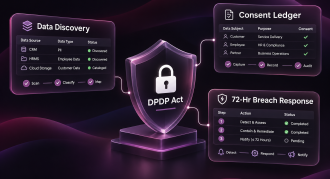
- Security safeguards: data discovery, encryption, tokenisation, masking and access hardening across cloud, on-prem and SaaS
- Consent ledgers: consent capture and audit trails that integrate with your apps and, where relevant, registered Consent Managers
- 72-hour breach SOPs: detection rules, scoping playbooks, notification workflows and tabletop drills
- Deletion jobs: retention policies turned into automated, logged deletion across databases, data lakes and backups
- Evidence packs: the logs, reports and records an auditor or the Board will ask for
Your counsel owns the interpretation. We own the implementation.
Frequently Asked Questions
What is the maximum DPDP Act penalty?
The highest single penalty under the Schedule to the DPDP Act, 2023 is up to ₹250 crore, for failing to take reasonable security safeguards to prevent a personal data breach. The Data Protection Board decides the actual amount case by case.
When can the Data Protection Board start imposing DPDP Act penalties?
The Board was constituted in November 2025, but core obligations such as security safeguards, breach reporting and children’s data rules apply from 13 May 2027. MeitY consulted on shortening this timeline in early 2026, but no amendment had been notified as of this article’s publication.
Is the 72-hour breach deadline the only notification requirement?
No. You must inform the Board and affected Data Principals without delay, and then file a detailed report with the Board within 72 hours of becoming aware of the breach, unless the Board allows more time.
Do DPDP Act penalties apply to Data Processors?
The Act places obligations, and penalty exposure, on the Data Fiduciary. Fiduciaries remain responsible for processing done on their behalf, which is why processor contracts and oversight are part of reasonable security safeguards.
How can we reduce penalty exposure before mid-May 2027?
Build verifiable controls (encryption, logging, consent records, deletion jobs and a tested breach SOP) and keep the evidence. Section 33 lets the Board weigh mitigation, timeliness and the nature of the breach, so documented controls matter.
Get Audit-Ready Before Mid-May 2027
DPDP Act penalties are severe, but they’re tied to controls you can build, test and prove.
Book a free 45-minute DPDP readiness call with Ekfrazo’s data privacy engineers. We’ll review your highest-risk systems against the penalty categories above and give you a prioritised engineering roadmap to get audit-ready before mid-May 2027.