Published: 27 November 2026 | Updated: 27 November 2026
By Arjun Rao, Principal Data Privacy Engineer, Ekfrazo Technologies, CIPP/A
A consent manager under DPDP Act rules is a company registered with the Data Protection Board of India that runs an interoperable platform where people can give, manage, review and withdraw their consent to businesses that process their personal data. The rules that let consent managers register, Rule 4 and the First Schedule of the DPDP Rules, 2025, took effect in mid-November 2026, one year after the Rules were notified. For most businesses, a consent manager is a new channel through which customers may send and withdraw consent. It does not replace your own notice and consent duties, which apply from 13 May 2027.
This guide explains who can become a consent manager, what they must and must not do, and what the November 2026 rollout means for your consent systems. It is a practical summary, not legal advice. Your counsel decides how the provisions apply to you.
What You Will Know After Reading This
- What a consent manager is under the DPDP Act, and how it differs from a consent management platform
- The nine conditions a company must meet to register, and the thirteen obligations it must follow
- How consent managers change consent records, withdrawals and integrations for businesses
- A six-step plan to make your systems ready to accept consent through a registered consent manager
What Is a Consent Manager Under DPDP Act Rules?
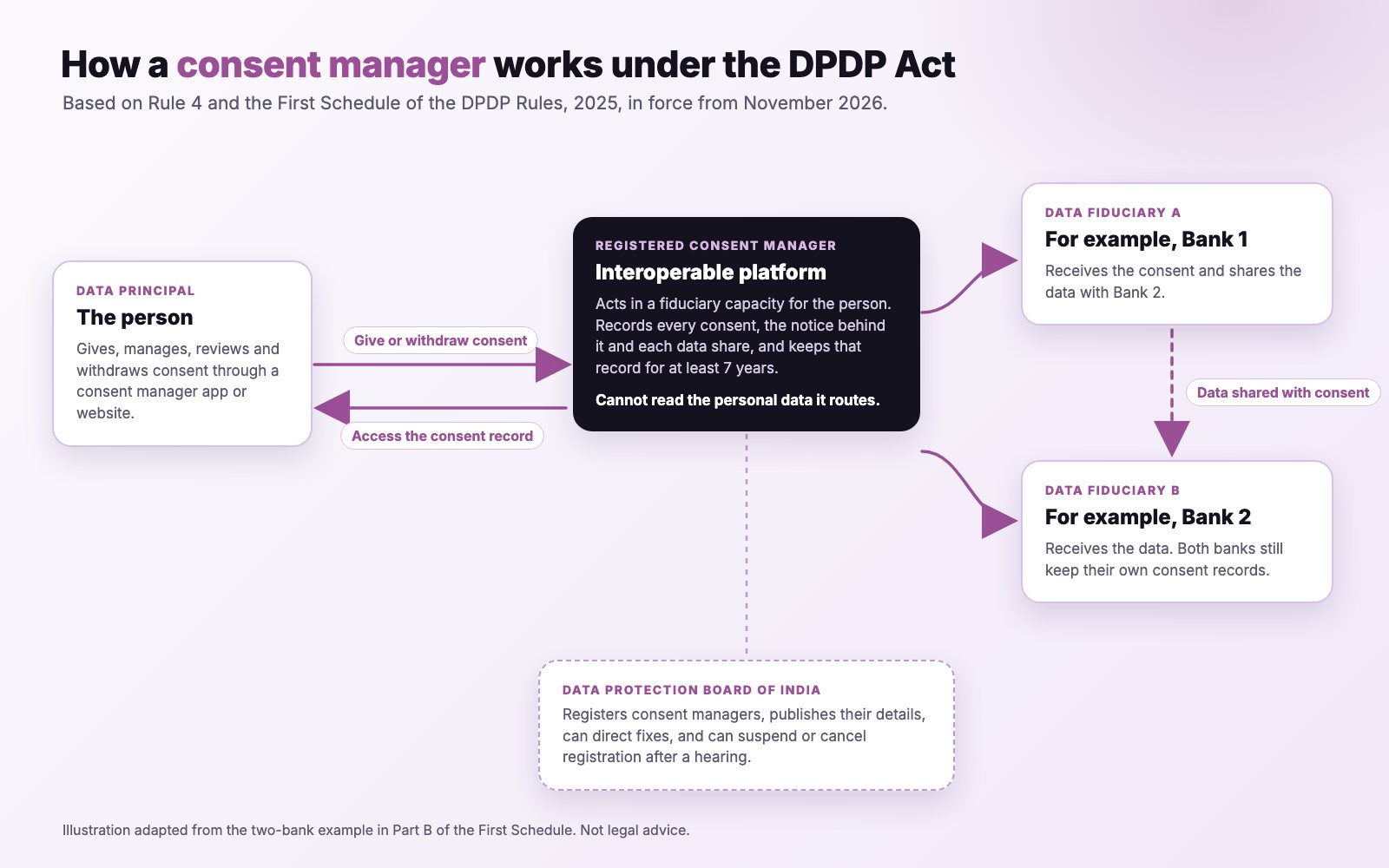
The Digital Personal Data Protection Act, 2023 lets a person (the Data Principal) give, manage, review or withdraw consent through a consent manager. The consent manager is accountable to that person and acts on their behalf, and it must be registered with the Data Protection Board. The DPDP Rules, 2025 add the detail: Rule 4 sets out how a company applies for registration, Part A of the First Schedule lists the conditions it must meet, and Part B lists its obligations once registered.
The Rules’ own illustration uses two banks. A customer of one bank can use a consent manager to let that bank share the customer’s data with a second bank, and the consent manager records the consent and the sharing without being able to read the data itself.
What Changed in November 2026
The Government notified the DPDP Rules in November 2025 with a phased start, as the Government’s PIB explainer and the DSCI insight brief on the Rules set out. The provisions for registering a consent manager under DPDP Act rules apply one year after notification, which is why they came into force in mid-November 2026, ahead of the core obligations for businesses in May 2027. Our post on every DPDP date from now to May 2027 sets out the full timeline.
Under Rule 4, a company that meets the Part A conditions applies to the Board with the particulars and documents the Board publishes on its website. The Board may make any inquiry it thinks fit. If it is satisfied, it registers the applicant and publishes the consent manager’s particulars on its website; if not, it rejects the application and gives reasons. The Board can later direct a consent manager to fix non-compliance and, after a hearing, suspend or cancel its registration in the interests of Data Principals.
Who Can Register as a Consent Manager
Part A of the First Schedule sets nine conditions. The bar is deliberately high, because a consent manager sits between millions of people and the businesses that hold their data.
| # | Condition of registration |
|---|---|
| 1 | The applicant is a company incorporated in India |
| 2 | It has the technical, operational and financial capacity to meet its obligations |
| 3 | Its financial condition and the general character of its management are sound |
| 4 | Its net worth is not less than ₹2 crore |
| 5 | Its volume of business, capital structure and earning prospects are adequate |
| 6 | Its directors, key managerial personnel and senior management have a record of fairness and integrity |
| 7 | Its memorandum and articles of association require it to avoid conflicts of interest, and those clauses can change only with the Board’s approval |
| 8 | Its proposed operations are in the interests of Data Principals |
| 9 | It is independently certified that its interoperable platform meets the data protection standards and assurance framework the Board publishes, with the technical and organisational measures to keep it that way |
What a Consent Manager Must Do
Part B of the First Schedule lists thirteen obligations. Four of them matter most to the businesses that will connect to a consent manager.
- A consent manager must make data available in a way that keeps the contents unreadable to the consent manager itself. It handles the consent and the routing, not the data.
- It keeps a record of consents given, denied or withdrawn, the notices that came with each request, and any sharing of data between businesses. It must keep that record for at least seven years, or longer if agreed with the person or required by law, and give the person access to it, in machine-readable form on request.
- It acts in a fiduciary capacity towards the Data Principal, and must avoid conflicts of interest with the businesses on its platform, including their promoters and key managerial personnel.
- It cannot sub-contract or assign any of its obligations, and its control cannot change hands by sale or merger without the Board’s prior approval.
The other obligations cover running a website or app as the main way people use the service, taking reasonable security safeguards against data breaches, publishing details of its promoters, directors and significant shareholders, and running audits that report to the Board on its controls, its continued eligibility and its compliance.
Consent Manager vs Consent Management Platform
The two terms sound alike and are often confused. A consent management platform (CMP) is software a business buys or builds to collect and store consent on its own website and apps. A consent manager is an independent, registered company that acts for the individual.
| Consent manager (DPDP Act) | Consent management platform | |
|---|---|---|
| Works for | The Data Principal | The business that deploys it |
| Registration | Must be registered with the Data Protection Board | No registration |
| Who must have one | Optional for individuals; a business may connect to registered consent managers | A practical tool for any business that collects consent |
| Sees personal data | No: the contents must not be readable by it | Depends on the product and its configuration |
| Record keeping | At least seven years under Part B | Set by the business’s own retention schedule |
Most businesses will need both: their own consent records and notices, which are required whether or not anyone uses a consent manager, and the ability to accept consent and withdrawals that arrive through one.
What Consent Managers Mean for Your Business
As a Data Fiduciary, you remain responsible for notice and consent. The Act places on you the burden of proving that you gave notice and obtained consent, so a consent manager’s record supplements your own; it does not replace it. In practice, consent managers affect businesses in four ways.
- Consent can arrive from outside your own apps. Your systems need to accept a consent, and the notice it was based on, from a registered consent manager and link it to the right customer record.
- Withdrawals can arrive the same way. Rule 3 and the Act require withdrawal to be as easy as giving consent, so a withdrawal sent through a consent manager has to stop processing in your systems, and at your vendors, within a reasonable time.
- Data sharing between businesses becomes traceable. Where two fiduciaries exchange data through a consent manager, both sides need to match the consent record to the transfer.
- Your notices must be clear enough to stand on their own, because people may read them inside another company’s app.
Should Your Business Connect to a Consent Manager?
| Connecting early usually makes sense when | It can wait for Board guidance when |
|---|---|
| You serve large numbers of consumers in India | You serve mainly business customers |
| You share personal data with other businesses with consent, as in banking, lending, insurance or healthcare | Personal data stays inside your own systems and named processors |
| Your customers already use data-sharing platforms in your sector | You hold mostly employee data under legitimate uses |
The Act lets individuals choose a consent manager; it does not require every business to build or appoint one. Check with your counsel and watch the Board’s announcements for any sector-specific expectations.
A Six-Step Plan to Get Consent-Manager Ready
1. Map every point where you collect consent
List each website form, app screen, call script and branch process that asks for consent, with the purpose and the systems that act on it. This is the same inventory you need for the DPDP Act compliance checklist.
2. Build one consent record for each customer
Store each consent with its purpose, the notice version, the channel and the time, in one place your systems can query. Consents from a consent manager should land in the same record as consents from your own apps.
3. Make withdrawal flow through to every system
Design an event or API that carries a withdrawal from the consent record to marketing tools, data warehouses and vendors, and log when each one stops processing.
4. Separate consent from legitimate uses
Document which processing relies on consent and which relies on a legitimate use under section 7, so a withdrawal stops only the processing it should.
5. Rewrite notices so they stand on their own
Itemise the data and purposes in plain language and explain how to withdraw and how to complain to the Board, as Rule 3 requires.
6. Test with a registered consent manager once your sector has one
When the Board publishes registered consent managers relevant to your business, run a pilot: send test consents and withdrawals through their platform and check that your records and systems respond correctly.
Frequently Asked Questions
Is it mandatory for businesses to use a consent manager under DPDP Act rules?
No. The DPDP Act lets individuals give and manage consent through a registered consent manager if they choose. Businesses still have to meet their own notice, consent and record-keeping duties, and should be able to accept consent and withdrawals that arrive through a consent manager.
Who regulates consent managers?
The Data Protection Board of India registers consent managers, publishes their particulars on its website, can direct them to fix non-compliance, and can suspend or cancel their registration after a hearing.
Can a consent manager see my customers’ personal data?
No. Part B of the First Schedule requires a consent manager to make personal data available or share it in a way that keeps the contents unreadable to the consent manager.
How long must a consent manager keep consent records?
At least seven years, or longer if the consent manager and the person agree or another law requires it.
Can a foreign company register as a consent manager?
Not directly. The first condition in Part A is that the applicant is a company incorporated in India, with a net worth of at least ₹2 crore.
What is the penalty for getting consent wrong?
The DPDP Act sets penalty caps by violation, from up to ₹50 crore for general breaches to up to ₹250 crore for failing to protect personal data. Our post on DPDP Act penalties explains each one.
Get Your Consent Systems Ready for May 2027
Ekfrazo’s security, GRC and engineering teams build the consent records, withdrawal workflows and integrations that the DPDP Act and consent managers require, alongside your legal counsel. See our DPDP compliance services, or book a free 45-minute readiness call to find out where your consent systems stand.